Relations
Which behaviors perform the same functional role?
From execution traces to a success-aligned tower of reusable agent skills.
College of Computer Science and Artificial Intelligence, Fudan University
* Equal contribution
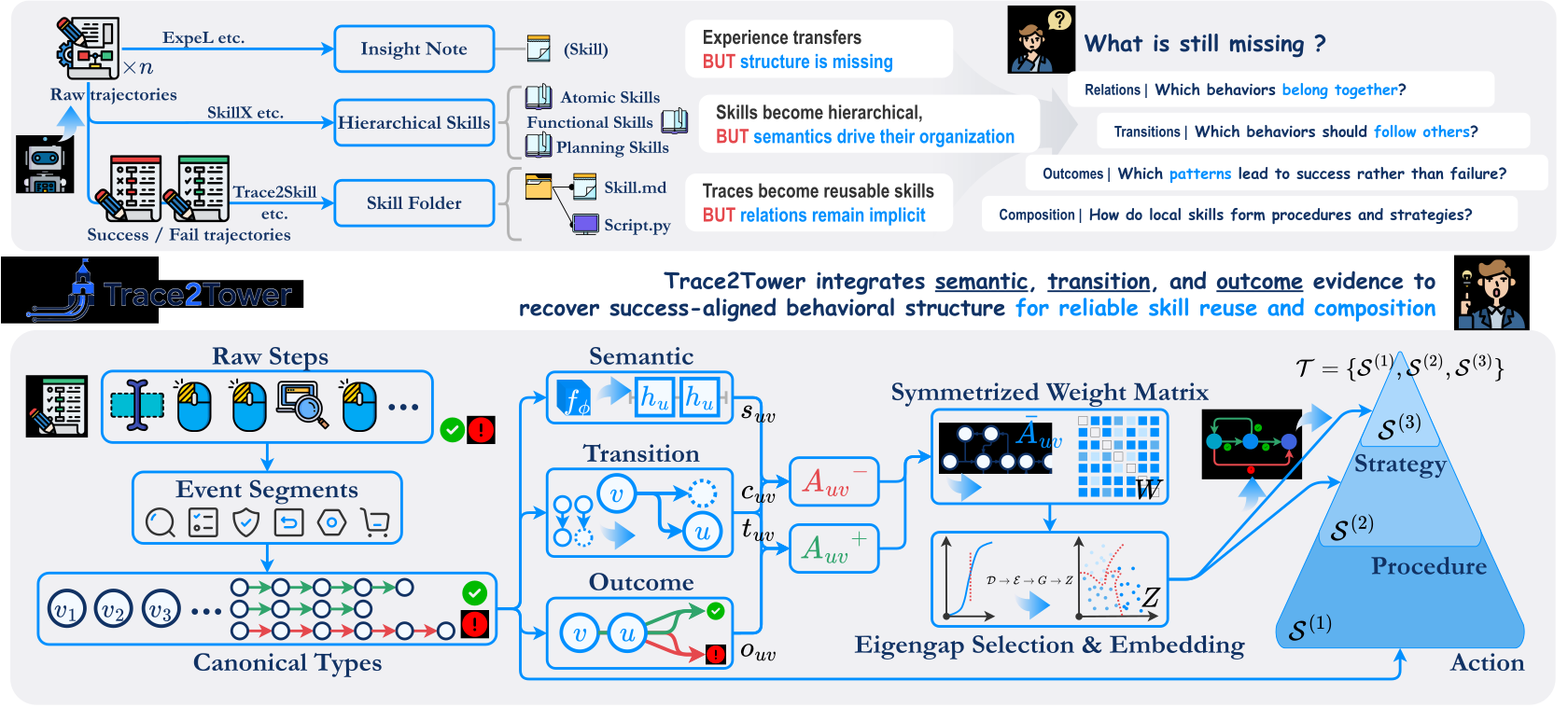
Overview
Existing agent systems retrieve trajectories or summarize flat skills, but they rarely preserve which behaviors belong together, which transitions are executable, and which patterns consistently lead to success.
Trace2Tower turns successful and failed interaction histories into canonical events, builds an outcome-aware transition graph, and uses contrastive spectral decomposition to identify stable behavioral modes. The result is a dynamic hierarchy of action templates, reusable procedures, and task-level strategies that supports compact retrieval and verifier-guided refinement.
What is still missing?
Which behaviors perform the same functional role?
Which behaviors reliably follow one another?
Which patterns align with success instead of failure?
How do local skills become procedures and strategies?
Method
Three stages preserve local semantics without losing temporal structure or outcome evidence.
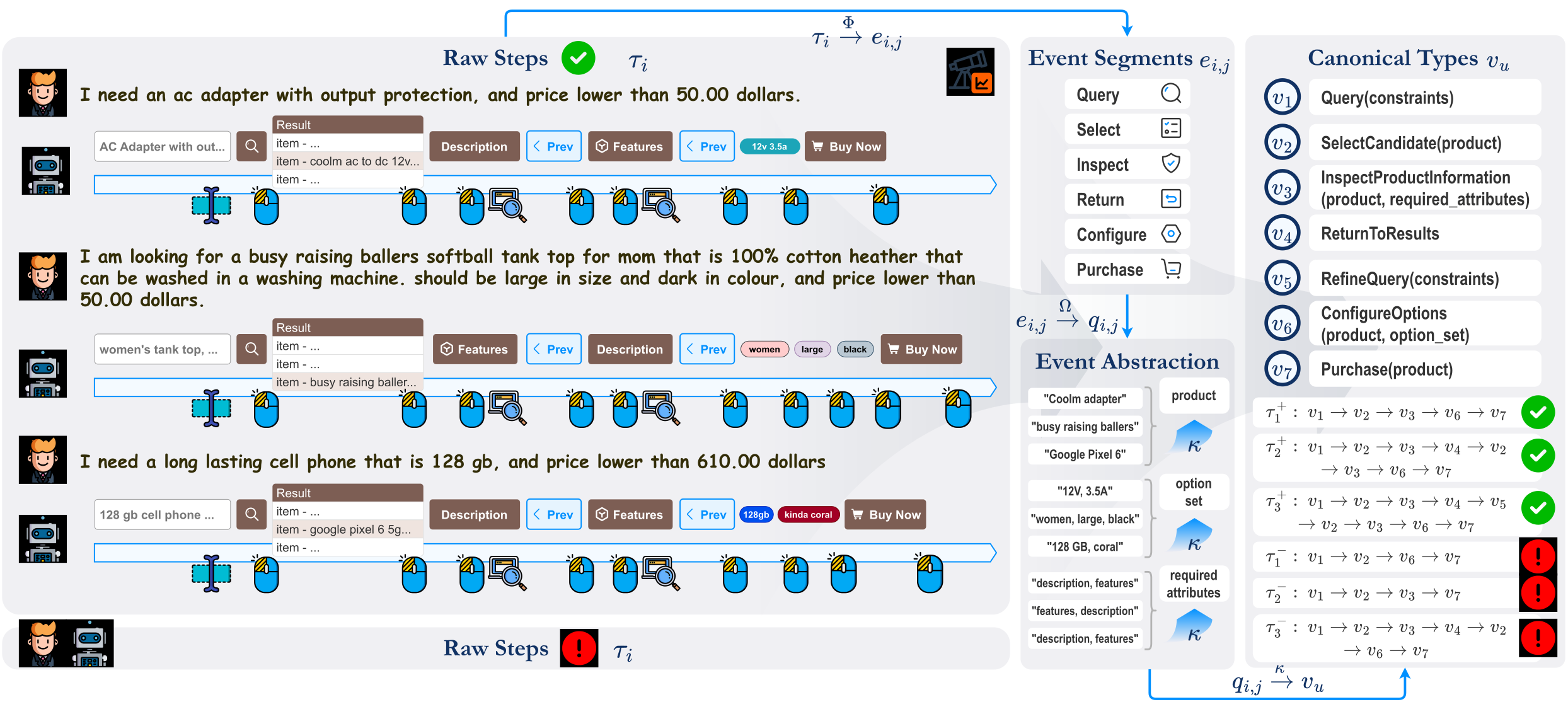
01 / Raw traces to events
Benchmark adapters replace task-specific entities with typed arguments while retaining subgoals, action families, observed state changes, and feedback.
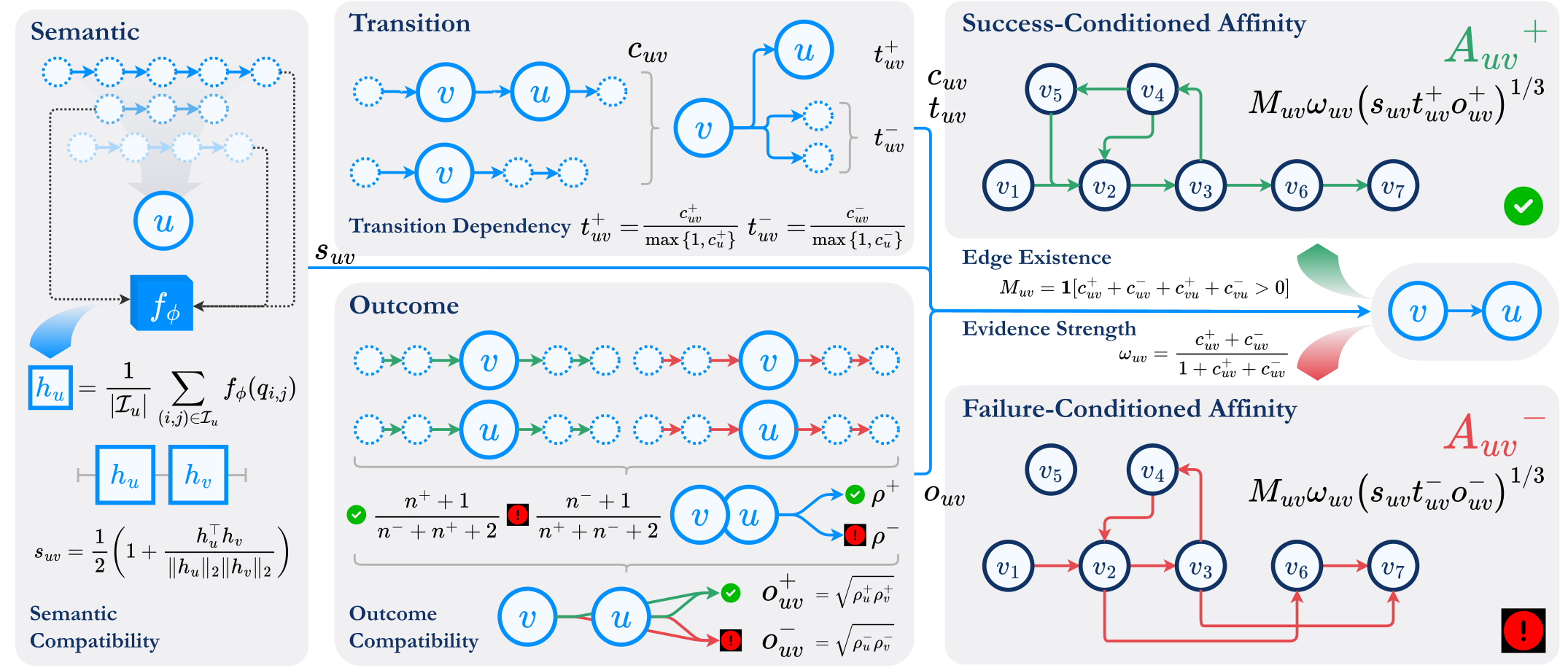
02 / Events to graph
Semantic compatibility transfers evidence across related events, transitions preserve executable direction, and outcomes distinguish useful dependencies from failure-correlated shortcuts.
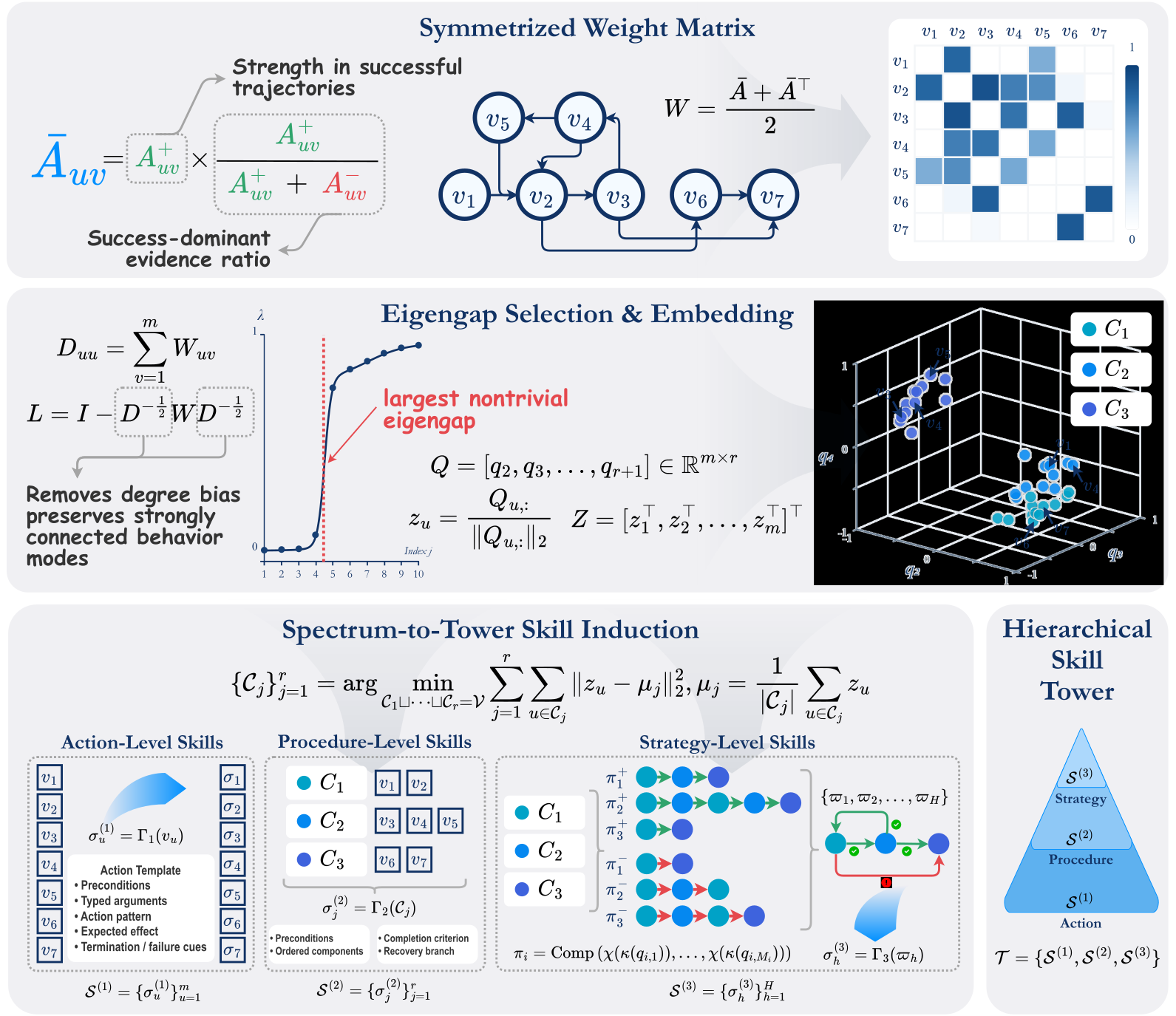
03 / Graph to tower
Component-wise spectral decomposition selects a natural procedure count. Success-supported procedure paths then become strategy skills for hierarchical retrieval.
Results
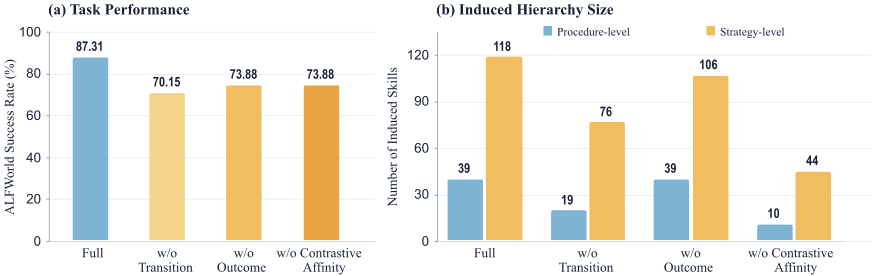
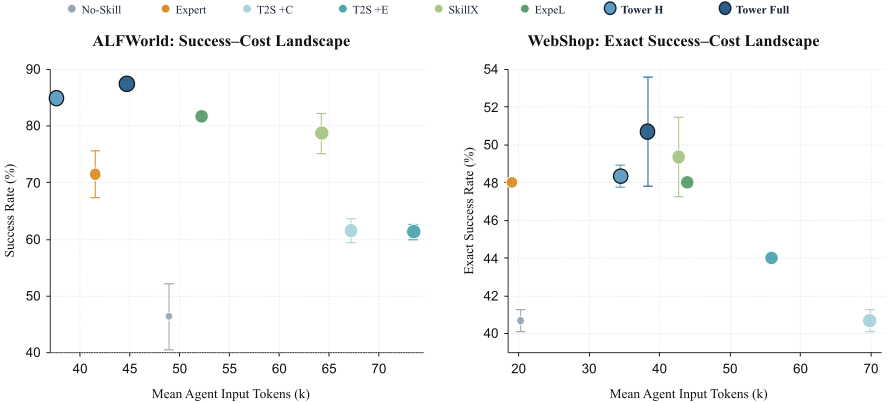
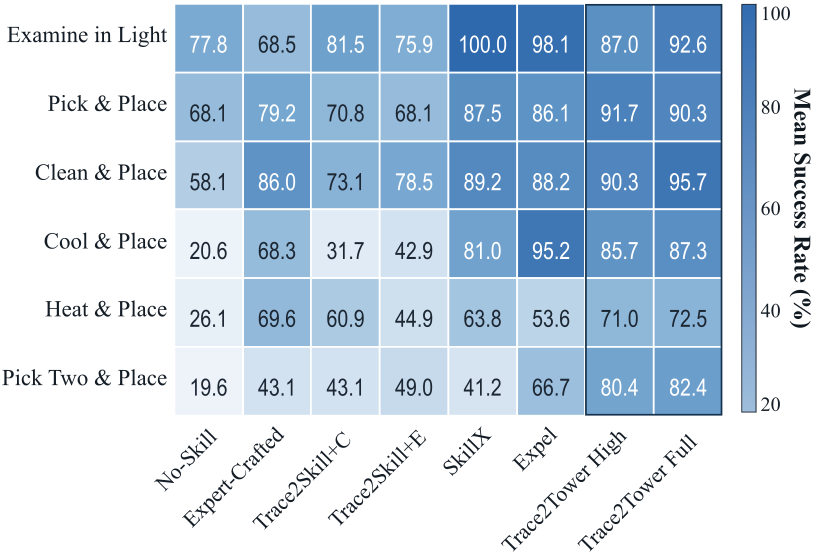
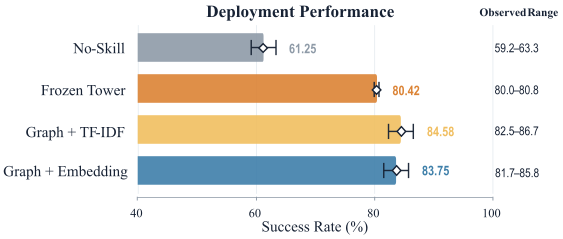
Trace2Tower improves task mastery while reducing unnecessary steps, invalid actions, and injected skill context.
Skill Tower
Strategy skill
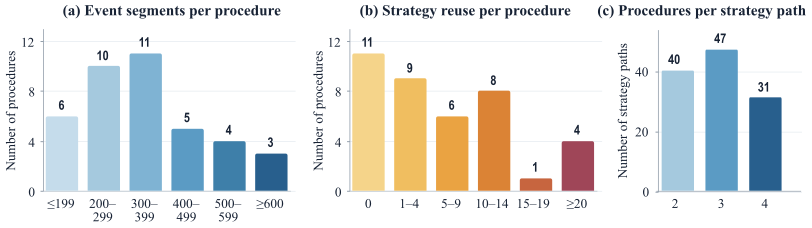
Maximal procedure paths supported by successful trajectories form compact plans for long-horizon execution.
Citation
@misc{sun2026trace2tower,
  title         = {Trace2Tower: Transition-Aware EigenTrace Induction
                   of Multi-Level Skills for LLM Agents},
  author        = {Jiazheng Sun and Boyu Yang and Binhao Yuan and
                   Mingxuan Li and Xin Peng},
  year          = {2026},
  eprint        = {2609.05261},
  archivePrefix = {arXiv},
  primaryClass  = {cs.AI},
  url           = {https://arxiv.org/abs/2609.05261}
}